History
History
The Zhung Dratshang (Central Monastic Body) is one of the oldest and most enduring religious institutions of Bhutan, with a history deeply intertwined with the spiritual, cultural, and institutional development of the Kingdom. Its origins can be traced to the establishment of a formal monastic community by Zhabdrung Ngawang Namgyal, the unifier of Bhutan and founder of the Drukpa state, in the early seventeenth century.
Following his arrival in Bhutan in 1616, Zhabdrung Ngawang Namgyal embarked upon a transformative endeavour to consolidate the country’s diverse religious and political communities under a unified system of governance and spiritual authority. In 1620, he established a monastic community at Chari (Cheri) Monastery in the upper Thimphu valley. The formal establishment of the Sangha marked a significant milestone in the institutionalisation of Buddhism in Bhutan and laid the foundation for what subsequently evolved into the Zhung Dratshang. The first formal monastic community is traditionally associated with a gathering of thirty monks.
The establishment of the Zhung Dratshang was closely associated with Zhabdrung Ngawang Namgyal’s vision of integrating spiritual and temporal governance. Through the institution of the Chhoesi system, religious and secular authority were organised as complementary pillars of the emerging Bhutanese state. The monastic establishment consequently assumed an important role in preserving and transmitting Buddhist teachings, conducting religious ceremonies, providing spiritual guidance, and sustaining the religious foundations of the nation.
As Zhabdrung Ngawang Namgyal consolidated Bhutan, the Zhung Dratshang expanded alongside the network of dzongs and monastic institutions established throughout the country. Following the construction of Punakha Dzong in 1637–1638, the principal monastic community was established there, and Punakha became an important center of religious and administrative life. The tradition of the Central Monastic Body moving between Punakha and Thimphu according to the seasons subsequently became an enduring feature of Bhutanese monastic life.
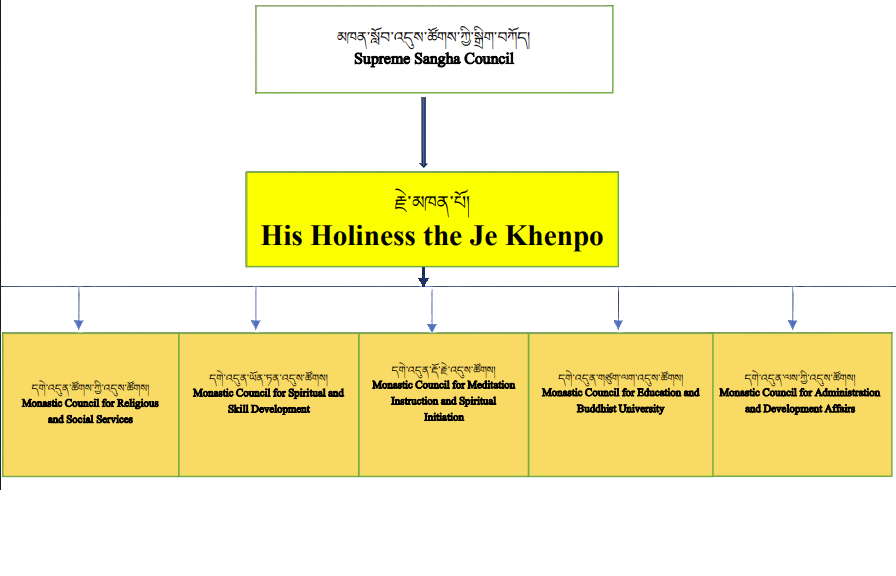
In 1651, Zhabdrung Ngawang Namgyal appointed Pekar Jungney as the first Je Khenpo, establishing the successive lineage of spiritual leadership of the Central Monastic Body. The institution has since continued under the guidance of successive Je Khenpos, who have served as the principal spiritual leaders of the Zhung Dratshang and custodians of Bhutan’s Buddhist heritage.
Throughout the centuries, the Zhung Dratshang has played a central role in the preservation and propagation of the Drukpa Kagyu tradition, while contributing significantly to Bhutan’s religious scholarship, monastic education, ritual traditions, cultural heritage, and spiritual life. Its network of monastic institutions and regional rabdeys has enabled the continuity of Buddhist learning and practice across generations.
The institution’s historical journey has continued through the transition from the traditional dual system of governance to the establishment of the hereditary monarchy in 1907 and, subsequently, to the constitutional democratic system of governance. The Constitution of the Kingdom of Bhutan recognises Buddhism as the spiritual heritage of Bhutan, while the Zhung Dratshang continues to fulfil its religious and spiritual responsibilities under the leadership of the Je Khenpo.
Today, the Zhung Dratshang remains a vital custodian of Bhutan’s spiritual heritage, carrying forward centuries-old traditions of Buddhist learning, contemplation, ritual practice, scholarship, and service. From its humble beginnings at Chari to its present institutional presence at Tashichho Dzong and Punakha Dzong, the history of the Zhung Dratshang reflects the enduring relationship between Buddhism, culture, and
the identity of the Bhutanese nation.
With a legacy spanning more than four centuries, the Zhung Dratshang continues to uphold the sacred traditions entrusted to it by successive generations, while responding to the contemporary spiritual and social needs of the people and contributing to the preservation of Bhutan’s distinctive Buddhist heritage.
Our location
Copyright © 2026. ZhungDratshang. All Rights Reserved.| Developed by WONS